
LLMs: The New Infinite Scroll
Personal thoughts on meta-awareness hijacking

I am convinced LLMs are the new infinite scroll.
How many of us here have opened an AI chat with a specific question, only to leave 12+ follow-up prompts later and a fully baked novel in your wake?
I think many of us, if not the majority, start off strong. We have an initial thought that needs fleshing out, a question that warrants further investigation, or perhaps, a concern that feels too private or scary to divulge publicly. Sometimes, even with close ones.
So we do what we do in 2026. We turn to our trusted AI companion, whether that be Claude, ChatGPT, Gemini, or Perplexity just to name a few. We start offloading our anxieties and curiosities faster than we can catch our own typos or hear our own thoughts. And naturally, we start expecting solutions as confidently as expecting the sun to rise tomorrow morning.
And suddenly, we are 10 prompts deep, and the original question is somewhere far behind us buried under a conversation we didn’t entirely choose to have.
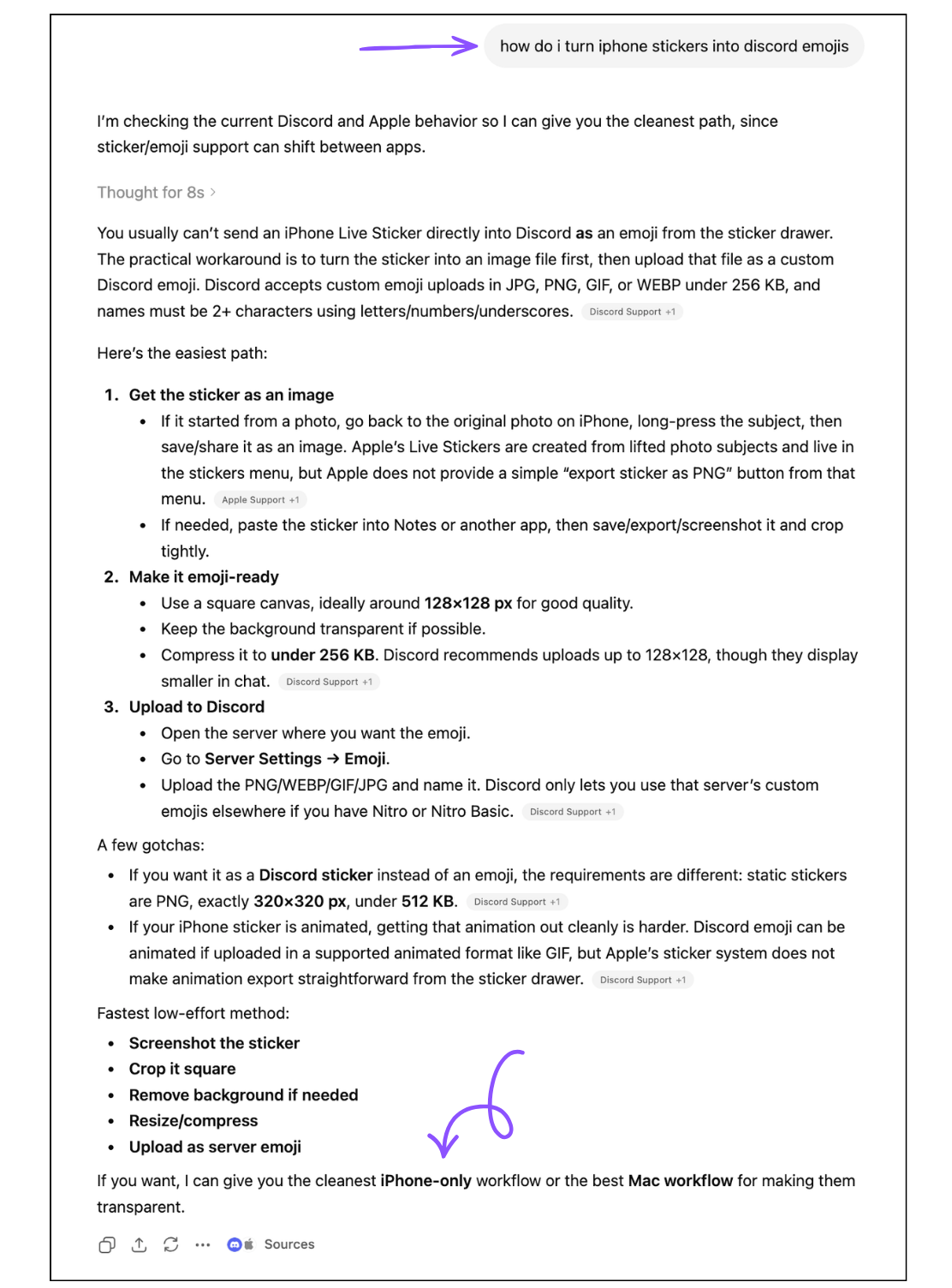
It’s even worse when we’re emotionally activated. A specific thought you brought to a chat gets inadvertently steered off course, and now you’re off-roading with anxious thoughts alongside an AI that has no idea how hard your heart is thumping or how high your blood pressure is running. It keeps generating, keeps responding, and doesn’t exactly know how or when to stop. And neither do we.
I want to explore the possibility that the risk here isn’t just having AI regurgitate your ideas back at you tenfold – although echo chambers and confirmation bias reinforcements are certainly a discourse we should continue to have. The deeper risk is that LLMs can quietly hijack your line of thinking and steer your awareness without you even noticing it’s happening.
Psychologists call this meta awareness – the mind’s ability to observe its own thinking, monitor goals, and notice when the mind has drifted from its original intention. It’s the part of your mind that asks, “Wait, what was I actually trying to figure out?”
Conversational AI platforms don’t do this maliciously. They follow your line of thinking with you, generously and fluently, one response at a time. But that generosity has a cost. They’re designed to think with you, to keep the conversation going. It helps you reason, but it might also redirect what feels important. It helps you articulate, but it can also be prone to over elaboration. It helps you reflect, but at times can keep you inside the reflection longer than you initially intended.
I don’t think that there’s anyone to blame here. The AI is what it is – a tool. And the person does what people do - reach for clarity when faced with uncertainty…often times before they’ve had time (or even allow themselves time) to sit with the question. What exists individually is not a problem. But the dynamic has the potential to produce patterns that I think warrant our close attention.
What I’m worried about is the byproduct of leaning in towards an AI faster than we spare our own intuition a split second. If we aren’t careful, LLMs can easily become the new infinite scroll – not stealing your attention, but quietly borrowing your mind.
There are many ways to define meta awareness drift. Cognitive load theory suggests that when working memory is overloaded, metacognitive monitoring can break down. Attentional capture helps explain involuntary shifts away from goal-directed behavior. Goal neglect, as Duncan described in 1995, names the tendency to lose track of intended goals under load or distraction. And the elaboration likelihood model gives us a useful lens for emotionally activated users, who may be more likely to follow an LLM’s framing without critically evaluating it. These are just some of the frameworks that relate to metacognitive hijacking.
I do want to note that redirection may be intentional in some cases, and not hijacking. And in those cases, thought disruption might even serve the person in front of the screen.
For example, an appropriate clinical response might interrupt the user’s original line of thought because the system recognizes distress signals and prioritizes safety over continuity. Epistemic care might look like the AI pausing to ask whether the person actually wants to keep going down a certain path, rather than assuming continuation is always helpful. Re-anchoring might mean returning the user to themselves – their original question, their body, their immediate needs, or their offline support systems – instead of generating more content simply because it can. In these cases, disruption is not the problem. The distinction is in whether the redirection serves the user’s agency, or silently replaces it.
So, what should the dynamic between humans and LLMs actually look like? Ideally, it should feel less like being pulled deeper into a conversation and more like being supported and oriented within one. People should come in with intention and ask, “Do I actually need to run this through AI, and what am I hoping to get out of it?” In return, the AI should not treat every prompt as an invitation to expand endlessly.
It should help the user notice whether they are still following their original goal or whether they have swerved into unintentional territory. And at its best, the interaction should strengthen the user’s relationship with their own intuition, not replace it. Because intuition – the ability to pause, sense, question, and decide what feels true before outsourcing the thought – is a skill no technology can imitate for you.
At this point in my meandering, I have decided to brainstorm next steps for closer research and evaluation.
To begin testing this in any rigorous way, a straightforward experimental design would involve two groups of participants using an LLM to work through a task. The independent variable is intentionality: one group receives a brief framing before they begin, like a prompt that encourages them to stay anchored to their original goal and notice when they start to drift. The other group receives no such framing, establishing a behavioral baseline.
But then here is where it gets complicated. The moment you tell someone to stay on task, you may be producing exactly the effect you are trying to study. This is the polar bear problem: Wegner’s classic suppression research showed that actively trying not to think of something makes it more intrusive, not less. Applied here, meta-awareness of goal drift could paradoxically increase it, which means the manipulation and the confound are the same variable. Any honest design has to name this tension upfront rather than engineer around it.
If that design problem were solved, the most meaningful signals to track would likely fall across four dimensions (at least the four I found). The first is cognitive load - operationalized through response length, the number of distinct topics introduced per exchange, and the volume of action items generated. Heavier outputs may indicate the LLM is expanding rather than clarifying the user’s thinking.
The second is attentional capture: how far does a conversation actually stray from where it started? A topic drift score - tracking distance between each response and the original prompt - could be coded manually alongside counting concepts introduced that were never in the user’s initial input.
The third is goal neglect. Does the LLM ever re-reference the original question after the second or third prompt? Does it help the user re-anchor, or does it simply keep generating? A prompt-to-original-intent alignment score across the arc of a conversation would be a meaningful signal here.
Finally, the fourth is peripheral processing. Under conditions of high cognitive load, users are more likely to evaluate LLM outputs through surface cues, accepting a response because it sounds confident, because it is long, or because it is fluently written, rather than evaluating whether it actually serves their original goal.
Now, for those of you who have stuck with me this far in my rant (bless you for that), you’re probably wondering – okay, where is the evidence now? What did you find? And the honest answer I have, and one you probably won’t like, is:
There are heavy caveats to researching this, and no clean way to study it while preserving both ecological validity and user privacy. (And if you find that there is, by all means please reach out to me because I would love to hear it).
Some of the most real and meaningful data lives in someone’s chat as unguarded conversations, existing as their most sensitive, personal thoughts and information. The ones people actually have with LLMs when they’re vulnerable, confused, or just trying to figure something out. Which brings up major flags:
They are too personal to share publicly.
They are too context-dependent to replicate in a lab.
And they are ethically fraught to collect – you’d need informed consent from people, who are by definition at this point, now in a meta-aware state (which ruins the study).
Which means the phenomenon you’re studying is almost designed to resist rigorous measurement. The moment you create controlled conditions, you eliminate the natural state that produces the effect. The moment you study real conversations, you hit privacy and ethics walls.
That difficulty is not incidental. It reflects how deeply these interactions are embedded in people’s private inner lives. And that should give us pause about how casually we’re deploying these systems at scale.
My final question for everyone is this: How would we test this? How do we study something that by definition disappears the moment you look directly at it? And DO we even test this? Meta-awareness hijacking is a silent threat. Not malicious, not obvious, not even intentional in most cases. Infinite scroll took years to name, and by the time we did, it had already rewired how millions of people relate to attention, reality, and each other. I don’t think we can afford to wait that long this time. The stakes are different when what’s being quietly borrowed isn’t just your attention, but your thinking.
If you’ve felt this in an AI chat that went somewhere you didn’t intend, in a moment where you looked up and couldn’t quite remember what you came for, I’d love to hear about it.
Maybe this is where the real research starts.